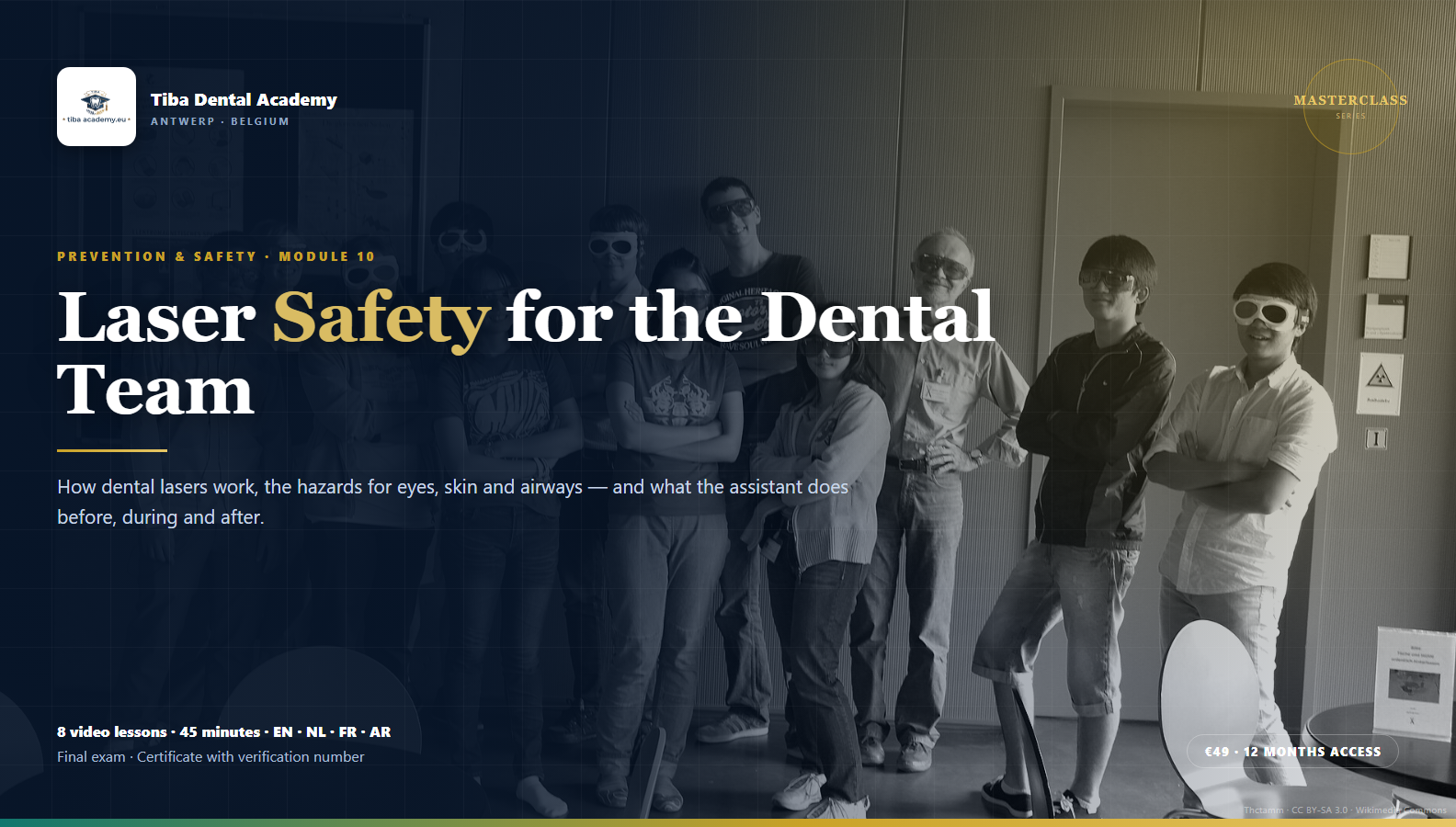
Laser Safety for the Dental Team
- 3 Sections
- 8 Lessons
- 1 Quiz
Understanding dental lasers
Protecting people
The assistant at work
Lasers are now standard in many dental practices, and every person in the room shares responsibility for using them safely. This course explains how dental lasers work, which hazards they create for eyes, skin and airways, and what the assistant does before, during and after a laser session. The content follows the international standard IEC 60825-1 and the European eyewear standard EN 207. It does not train you to operate a laser: in most countries only a dentist or a specifically trained professional may do so.
- Laser basics: wavelength, absorption and how each dental laser acts on tissue
- Laser classes: IEC 60825-1, and why most dental lasers are Class 4
- Eye protection: choosing eyewear by wavelength and EN 207 marking
- Plume and fire: evacuation, masks and fire prevention
- Your role: room set-up, communication and checks before, during and after the session
What you will be able to do
- Explain how a dental laser works and why wavelength defines the hazard
- Identify the laser class of your device (IEC 60825-1)
- Select protective eyewear by wavelength and EN 207 marking
- Prepare the room: sign, suction, fibre, patient protection
- Control the plume and prevent fire risk
- Act correctly in the first 60 seconds after an exposure
What is included
- 8 short video lessons, about 45 minutes in total
- A one-page protocol you can print and keep at the chair
- A final quiz (70% to pass) and a certificate of completion
- 12 months of access, including future updates
Who it is for
Dental assistants who work with diode or erbium lasers, reception staff who enter the room during treatment, and dentists who want their team working from one protocol.
Important: this module teaches safety, not operation. In most countries only a dentist or a specifically trained professional may operate a laser. The certificate is a certificate of completion for continuing education — not a state-recognised diploma.
Certificate
After the final quiz (70% to pass) you receive a dated certificate of completion with a verification number. It goes into your professional file and stays available in your account. It is a certificate of continuing education — not a state-recognised diploma.
Frequently asked
Do I need to own a laser?
No. The module is about safety in the room, not about operating a device.
How long do I have access?
Twelve months from enrolment, including future updates to the module.
Can my whole team take it?
Yes — see the team offer for one invoice and a progress overview per assistant.
Is it in my language?
This module is published in English, Dutch, French and Arabic.
Continue with
If you treat patients with a laser rather than assist, the advanced module covers dosimetry, protocols and the evidence: Laser-Assisted Periodontal & Peri-Implant Therapy (€199).
شاهد الدروس مجاناً
كل درس على يوتيوب مدته أقل من دقيقة، بصوت وشرائح. الفيديوهات أدناه هي دروس الموديول الثمانية بالترتيب.
النسخ العربية والفرنسية والهولندية قيد الرفع على نفس القناة: @tibabelgium607
Instructors
- Dr. Hicham Oukal — Course Director, Tiba Dental Academy. Dental hygiene specialist with expertise in laser dentistry and oral rehabilitation; more than 15 years of clinical and management experience in Belgium.
- Dr. Mohammed Abdel Fattah — Root canal and laser specialist at Tiba Center for Oral and Maxillofacial Surgery, Antwerp. Endodontic treatment and minimally invasive procedures.
Want to submit a review? Login
Related Courses

Oral Health Education & Prevention
